

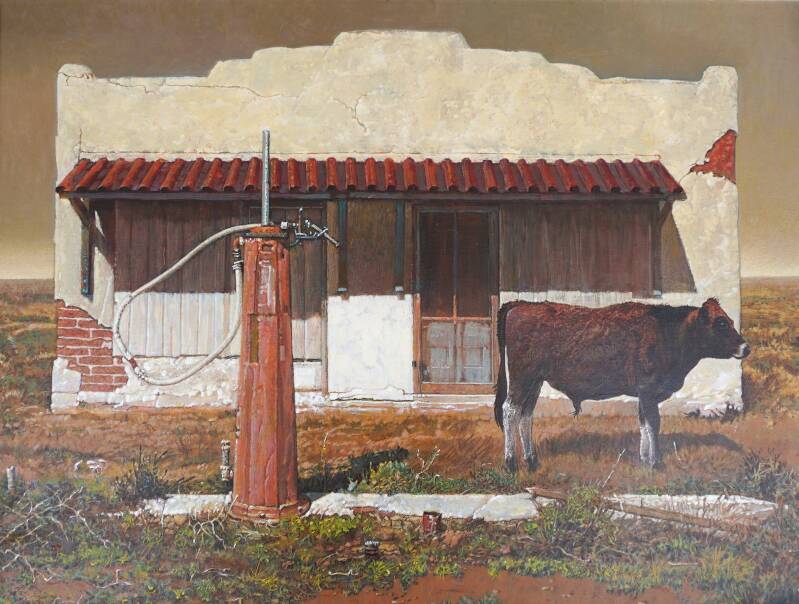
Out of Gas. Leighton Fossum casein and ink
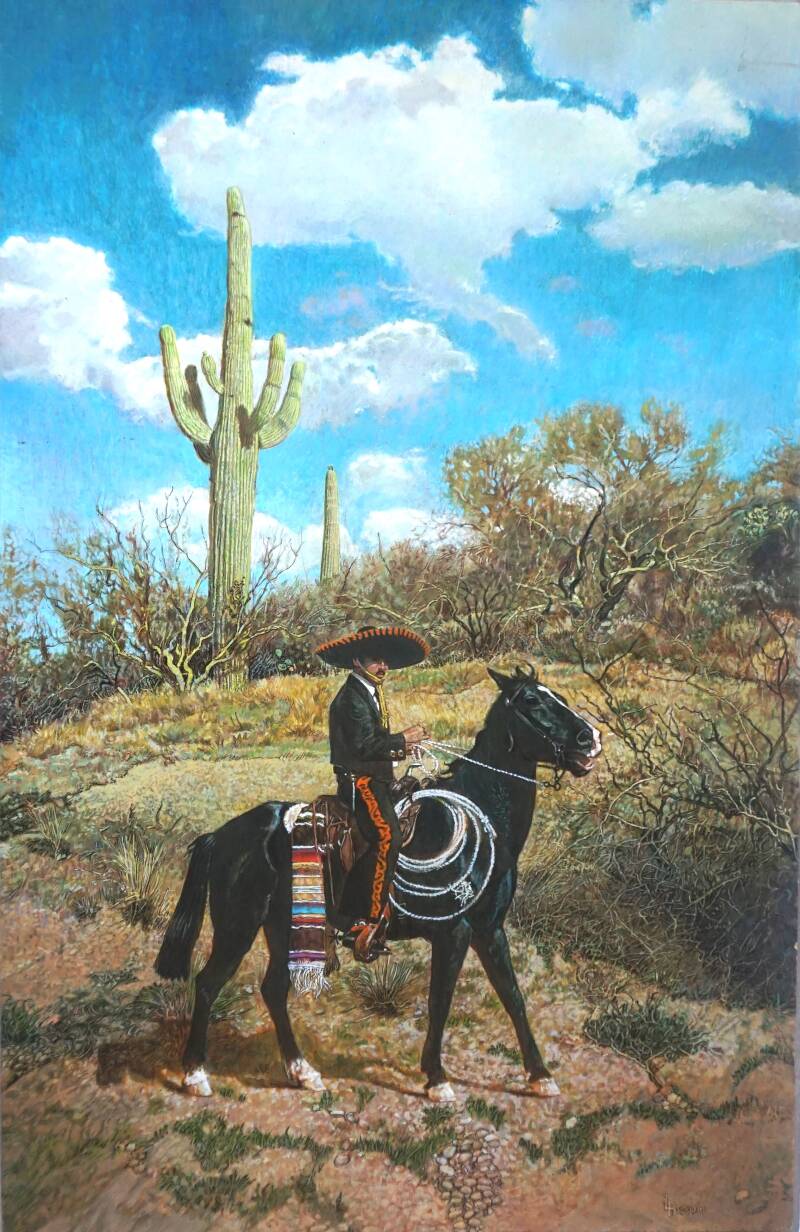
Vaquero by Leighton Fossum. Casein paint and ink.
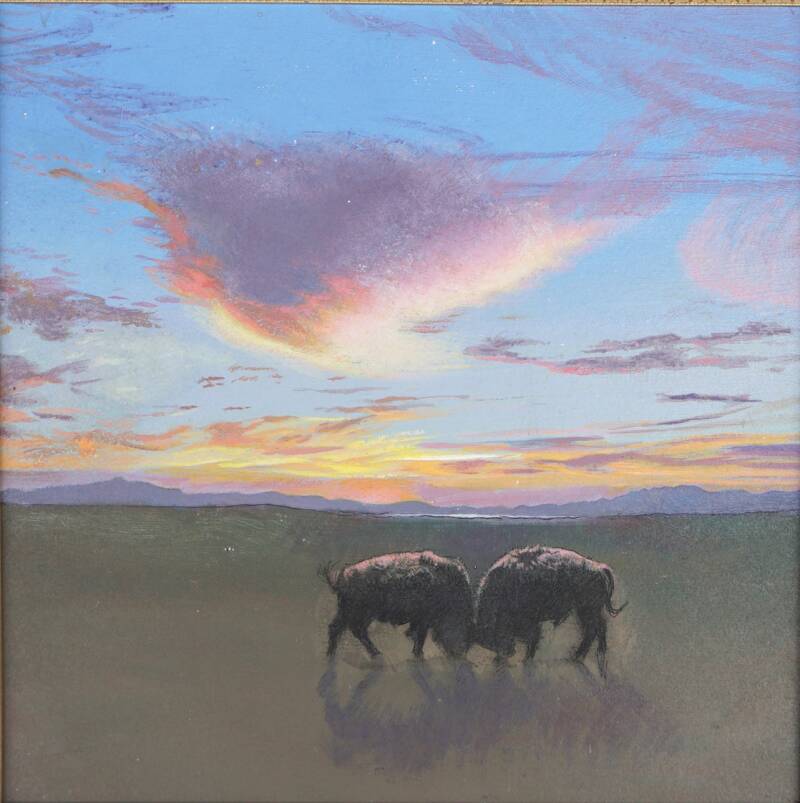
My Territory by Leighton Fossum. Casein paint.
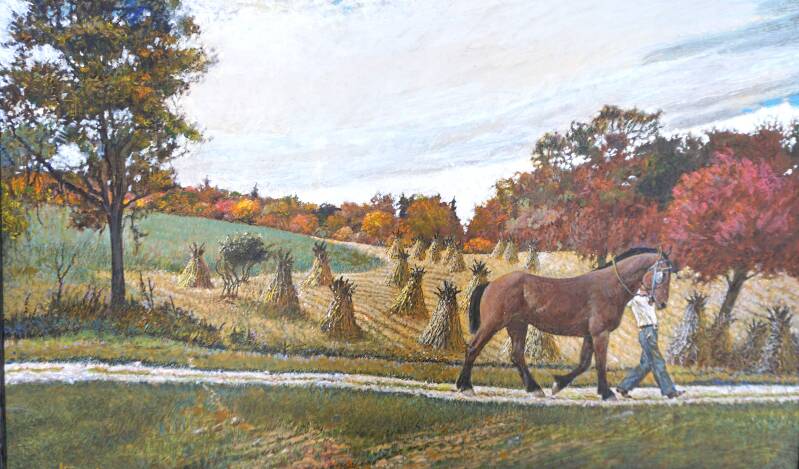
Going Home by Leighton Fossum.
Casein paint and ink.
LEIGHTON FOSSUM
Artist and Illustrator, 1922–2011
By Victoria Chick, contemporary figurative artist and early 19th & 20th century print collector
A treasure trove of paintings, documents, and books was left behind after the death of artist and illustrator Leighton Fossum. Put together, they reveal the talent and interests of a man who led an amazingly diverse life. Several of his works now belong to the permanent collection of the Southwest Regional Museum of Art & Art Center in Silver City, New Mexico.
Fossum was born in Thief River Falls, Minnesota, a town on the historic Jefferson Highway, the early auto trail that ran from Winnipeg to New Orleans. He attended the Minneapolis Art Institute and the New York Art Students League, then became a productive graphic designer and commercial artist in Minneapolis, another city on the Jefferson Highway route. The invoice books found in his files show how in demand his skills were. He also illustrated children’s books and educational materials. Black Cowboy: The Story of Nat Love by Charlotte Clark, published in 1970, was illustrated by Fossum.
He gained a reputation as an outdoor artist, creating paintings that became limited edition prints for the Rapala Fishing Lure Company. His paintings were also featured on the cover of Rapala catalogues, and those prints are now collectors’ items.
His profound attention to detail is most evident in the paintings he did after he retired from commercial art. Fossum’s shift toward fine art coincided with his move in the 1980s to the desert areas of Arizona and, later, New Mexico. He roamed the area recording what he saw in sketchbooks and with a camera, and whatever interested him was likely to be incorporated later into a painting.
A mixed media approach to defining visual texture was a method he often employed. Fossum worked mostly on gessoed panels, preferring casein, gouache, fine-point pen and ink, and the humble pencil to build up textures. Weathered wood, plant life, rocks, and objects worn by the Southwest wind and sun make the viewer certain that Fossum was a sharp observer. Some of his paintings depict historical events or historic figures, which he researched carefully to get the details right. His love of horses is reflected in the many paintings that include them.
The newest addition to the museum’s collection, a painting of a vaquero, shows one of the subjects that interested Fossum. In the Southwest he met several Mexican American groups that organized and took part in traditional Spanish-Mexican equine activities, and he enjoyed all of it: cowboy, rodeo, and vaquero events. Having grown up in northern Minnesota, he found Arizona and New Mexico full of wonders after he retired from commercial art and threw himself into Southwest experiences.
Vaquero by Leighton Fossum. Casein paint and ink.
His work also carries a dry sense of humor: a cow standing beside a gas pump, a tumbleweed sailing through the air in front of a landscape you only notice on a second look. Fossum developed his compositions in the studio from sketches and photographs, and he often pushed a composition to its edge on purpose, such as a cow’s nose just barely crossing the edge of a building. It’s the kind of detail most viewers never consciously notice, but a trained designer’s eye would.
Out of Gas by Leighton Fossum. Casein paint and ink.
Sorting through his belongings after his death revealed even more of the man: records of his inventions, his Air Force discharge papers, and his easel, covered with sketched faces as if his thought processes had been scribbled across it. In addition to his life in commercial and fine art, he served in WWII, was a pilot, inventor, and patent holder. Fossum sold works through several galleries in Tucson, Arizona.